 |
Conflict in the Mountains:
The Story of Corridor H in West Virginia |
|
Conflict in the Mountains:
The Story of Corridor H in West Virginia |
| Corridor H (US
48) was legislatively created as part of the 1965 Appalachian Regional
Development Act. This route which was designated to run east from
Weston via Elkins to Strasburg, Virginia has been West Virginia's most
controversial route of the six Appalachian Highway Development System routes
that run within the state's borders. The emotional conflict that
has led to numerous legal and political struggles has placed the environment,
desire for economic and social progress, and the Eastern West Virginia
way of life at odds with each other for nearly four decades.
Early History:
Corridor H would be one of six (D, E, G, H, L, and Q) AHDS routes planned for and ultimately built in West Virginia. Most of these routes were improvements tied to existing US highways, either through building new alignments or improving the current road. Corridor E would be built entirely to freeway standards and become I-68 in 1991. The remaining corridors have become key links within West Virginia's highway system.
|
| Problems Begin:
The original proposed routing of Corridor H had the improved highway following US 33 from I-79 east to Elkins then continue east via US 33 to Seneca Rocks. From that point east, there were two proposals: one was a new terrain route over the Shenandoah Mountains to New Market, Virginia. (3) The other had Corridor H going north from Seneca Rocks to Moorefield and then east roughly following Route 55 to Strasburg. (1) However, the new highways never saw the light of day. Environmental groups quickly voiced concerns and protested the route east of Shavers Fork. In 1981, WV began the process of studies and hearings on an Environmental Impact Statement for the highway east of Shavers Fork. Any progress from the studies and hearings stalled as funding issues would cause the state would shelve the project until 1990. (4) Meanwhile, the state would begin in
1982 twelve years of constructing nearly 40 miles of Corridor H from I-79
east to just west of the city of Elkins. This project was an improvement
of US 33 and included a bypass of Buckhannon.
|
| The 1990s: The Conflict Comes
to a Head
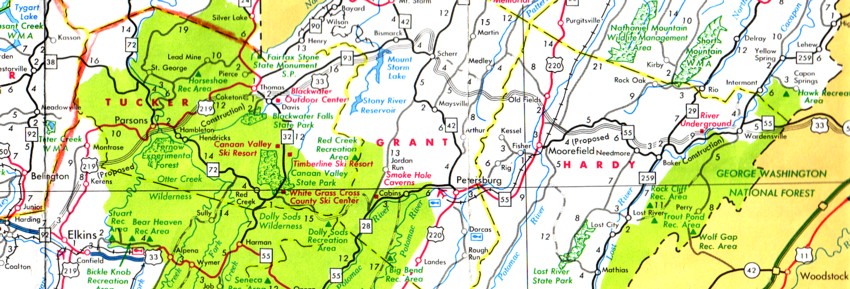
The 90's would see a re-energized West Virginia in pushing forward the completion of Corridor H. Sen. Robert Byrd (D-WV) would be named chair of the Senate Appropriations Committee in 1990 and he would soon begin issuing federal highway dollars to his state. The WVDOT would begin a two part study as well. The two part study included a Corridor Selection Draft Environmental Impact Statement (CSDEIS). The five alternative study was released in 1992. (2) In 1994, WVDOH completed their Alignment Selection Draft Environmental Impact Statement (ASDEIS). The study would release a new corridor for 'H'. This corridor had the highway running northeast from Elkins to Parsons, east from Parsons to Davis, then a northern arc route via Bismark and Scherr to Moorefield, then running east to Virginia in the shadows of current WV 55. (see map below). The four-lane portion of highway directly east of Elkins and part of the original Corridor H would not be part of the new route. It is know locally known as the "racetrack".
It would be the decision of the Northern Route that would begin a legal battle between the state and various opposition groups. The battle would continue to intensify between 1994 and 1996. During that time period, a citizen's group named 'Corridor H Alternatives' (CHA) was formed. The grass-roots group which favors other alternatives to the new highway would become the most vocal and active of those against the highway. The group would receive unexpected support from the Commonwealth of Virginia in 1995. The Commonwealth would announce that they did not have any current interest in completing Corridor H from the State Line to Strasburg. Their position would be a large contrast to that of former WV Governor Cecil Underwood, who would state that his administration's goal was to "...move aggressively toward construction of every segment of Corridor H as we have been financially and legally permitted to do so." (5) The state would release their Final Environmental Impact Statement (FEIS) in April 1996 and the Federal Highway Administration would announce a Record of Decision (ROD) approving the 100 mile route four months later. In November, CHA would file suit in federal district court against the FHWA's ROD in addition to WVDOH. CHA would allege that the state did not study improving existing routes, but rather push for the new highway. They also would allege that WVDOT ignored impacts on two historical sites the Corricks Ford and Mooresville Civil War Battlefields. The claim states that FHWA was in violation of Section 4(f) of the Department of Transportation Act and Section 106 of the National Historic Preservation Act. They argued that "...[the] FHWA violated DOTA Section 4(f) by failing to identify all the historic sites it was charged with protecting prior to its decision approving the route of the proposed highway, and by erroneously concluding that the highway would not "use" two of the sites it did identify [section 106]..." (6) The U.S. District Court would side in favor of the FHWA and WVDOH in October of 1997; however, CHA would immediately file an appeal. (4) CHA would be joined throughout the legal dispute by 14 other plaintiff's and six friends of the court. (1) The co-plaintiffs and friends of the court would include environmental groups, local citizen's groups, and also national taxpayer watchdog organizations. CHA would file a second lawsuit in 1998 on the same grounds in regards to two other properties. The second lawsuit would be dismissed in march of 1999. The battle over Corridor H would continue to intensify in 1998 up to the calming of compromise in 1999. In November 1998, a federal court ordered the WVDOH to halt all work on Corridor H except for a 3.5 mile segment of the North Elkins Bypass. (4) The beginning of calmer days came with a US District Court of Appeals decision on February 9, 1999. The decision agreed that the two agencies did consider all alternatives, including improving existing routes, throughout the EIS processes. However, it reversed the original decision of the FHWA not being in violation of Section 106 of the NHPA and of Section 4(f) of the DOTA. The decision would allow the CHA to file new lawsuits on future projects based on any possible violations of Section 106 and Section 4(f). (4) The state would be allowed to complete the North Elkins Bypass and continue all studies for the rest of the highway. The true compromise came in December
1999 as a result of the US District Court Mediation program. The
compromise broke the original ROD on the 100 mile route into nine segments.
ROD's would be issued for each segment. The CHA would in turn "...waive
the right to bring future lawsuits seeking further study of any alternative
that does not include completing Corridor H as a continuous four-lane highway."
(4)
|
| Stimulus Funding vs. Wasteful
Spending:
During the first six months of the Barrack Obama administration, funding for Corridor H saw a boost and then a pull back. The American Recovery and Reinvestment Act of 2009 awarded West Virginia $215 million for highway construction. In February of 2009, Gov. Joe Manchin announced that $21 million would go to Corridor H projects in Grant and Tucker counties. (7) However, two months later, the $21 million for Corridor H was transferred to a bridge project in Weirton. The main reasons were that Senator Robert Byrd had earmarked $9.5 million for Corridor H for 2009-2010; and the state had already committed between $13-15 million of their own to the project. (8) That all changed in May when the President announced his budget proposal. The White House's budget eliminated Byrd's $9.5 million earmark as part of $17 billion worth of budget cuts. (9) Byrd along with fellow Senator, Jay Rockefeller, and other West Virginia Congressmen vowed to put the $9.5 million earmark back into the budget. Meanwhile, the West Virginia legislature began looking into whether or not they could move the stimulus money back to Corridor H. But prior, there was some doubt that the Corridor H projects in the stimulus package were in fact "shovel ready". (10) Regardless, Corridor H backers and West Virginia officials have stated this is only a minor hurdle in the continued construction of the highway. |
| US 220 Improvements (North-South
Corridor):
As a result of Corridor H nearing completion to Moorefield and the route's push westward towards Elkins, local leaders and residents looked at improving US 220, a two lane north-south highway connection Moorefield to Cumberland. Called the North-South Corridor, the hope is for a modern four lane highway connecting Corridor H in Moorefield to Interstate 68 in Cumberland. Although years away from any construction, the West Virginia Department of Transportation initiated a Tier I Environmental Impact Study in November 2005. The preliminary study is expected to take 18 months and be completed by mid-2007. The study is spread over four states (Maryland, Pennsylvania, Virginia, and West Virginia) and looks at four potential routes: (11)
After a series of meetings in 2007, the possible routes were whittled to three. Option 1) Took the road along US 220 from Cumberland to WV 93 in Scherr and would connect with Corridor H there. Option 2) Runs the highway along Knobley Mountain. Option 3) Follows US 220 to Keyser and then heads south to Moorefield. (15) In May of 2006, the WVDOH held three public information hearings on the possible alternatives on the North-South Corridor. |
Where Corridor H is Today:
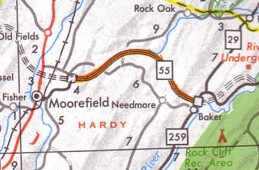 The
nine segments would be re-evaluated on an individual case and construction
on some segments would begin in earnest in 2000. One of the first
segments of Corridor H to be opened was the North Elkins Bypass in August
2002. More openings would take place in 2003 as 14 miles of highway
from Baker to Moorefield opened. (See map at right) Construction was recently
completed on a segment east of Baker and WV 259 to Wardensville for seven
miles of the highway. This segment opened on October 20, 2006.
Currently, a number of miles of Corridor H is under various phases of construction. The
nine segments would be re-evaluated on an individual case and construction
on some segments would begin in earnest in 2000. One of the first
segments of Corridor H to be opened was the North Elkins Bypass in August
2002. More openings would take place in 2003 as 14 miles of highway
from Baker to Moorefield opened. (See map at right) Construction was recently
completed on a segment east of Baker and WV 259 to Wardensville for seven
miles of the highway. This segment opened on October 20, 2006.
Currently, a number of miles of Corridor H is under various phases of construction.
Westwards from Moorefield, a three mile piece of the 15 mile Moorefield to Forman segment opened to traffic in November 2005. (4) This extended the highway west to end at US 220 just north of Moorefield. The remaining 12 miles of this section opened to traffic on October 27, 2010. This will extend the highway to Patterson Creek Road (County Route 5). Local traffic will be able to continue another 3.5 miles to Knobley Road (County Route 3). (20) This "local traffic only" section is part of the Forman to Bismark section currently under construction. The remainder of the 14.5 mile Forman to Bismark section is currently under construction. A number of contracts including a 0.6 mile connector route from WV 93 to Corridor H in Schrerr are underway. (18) A completion date of 2013 has been announced. (17) The next segment east is a 16.2 mile segment from Bismark to Davis that will parallel WV Route 93. Construction is underway for this segment, as the state has accelerate contracts to complete the route to Davis by 2013. (21) Some of Corridor H near Davis will be built on top of Route 93. (19) Meaning the existing highway will be used for two or the highway's four lanes. As a result, only two new lanes of highway will need to be built. The final 22.5 miles have the most hurdles to clear. The 22.5 miles are broken into two segments, Davis to Parsons (9 miles, and Kearns (the end of the North Elkins Bypass) to Parsons (13.5 miles). The Davis to Parsons section is home to the environmentally sensitive Blackwater Canyon region. The state had hoped for a Supplemental Final Environmental Impact Statement (SFEIS) and Record of Decision in late 2001 but that had been pushed back to 2003 then to the fall of 2005. (4,16) The state had expected an approval Record of Decision (ROD) announced in October 2008. (17) This section - with the exception of Wardensville to the WV/VA line - is expected to be built last. As of this article's last update, construction is not scheduled to begin on this segment until 2031. The Parson to Kearns segment received a ROD in 2003; however, the state's current goal is to begin construction of this segment in 2018. (17) CHA noted during the FEIS comment period that the North Elkins Bypass needed 2.5 times more excavation than originally planned. (16) This segment includes the Corrick's Ford Battlefield. Finally, the furthest east segment, Wardensville to the VA line, is in the most limbo. Construction of this segment was deferred 20 years as a result of a February 2000 agreement with CHA. (16) This segment though can begin construction sooner if traffic warrants. Currently, the state expects to begin construction of the final eastern most miles of Corridor H in 2027. Another aspect of the February 2000 agreement was West Virginia agreeing to pay Wardensville $1 million in capital improvements as a result of potential damage to the town's economy from construction Corridor H. (16) |
| Site Navigation:
Sources & Links:
Page Created: May 28, 2005
© 2005-10 William
Lawson
|
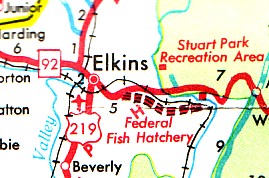 Construction
of Corridor H would start slowly. By 1974, widening projects were
beginning on US 33 immediately east of I-79 near Weston. The only
sign of significant construction of the highway was a six mile stretch
of highway being built on a new alignment east of Elkins. (see map
at right) The roadway from Canfield to Shavers Fork was opened in
the mid-1970s.
Construction
of Corridor H would start slowly. By 1974, widening projects were
beginning on US 33 immediately east of I-79 near Weston. The only
sign of significant construction of the highway was a six mile stretch
of highway being built on a new alignment east of Elkins. (see map
at right) The roadway from Canfield to Shavers Fork was opened in
the mid-1970s.